Guides / Accounts and currencies
How to Manage Multiple Accounts and Currencies
Cash, bank, credit card, and foreign-currency accounts in one place. How to set them up, how transfers between them work, and how to keep every balance honest.
Nobody actually has one pot of money. You’ve got some cash in your wallet, a current account, a credit card you’re trying not to think about, and quite possibly an account in another currency from freelancing, or working abroad, or a trip you haven’t fully closed the books on.
An expense app that assumes a single balance makes you either ignore most of that or mash it into one number that isn’t true anywhere.
One account per real-world pot
The setup that works is boring and effective. Make an account for each place your money genuinely sits: Cash for your wallet, Bank for your main account, Credit Card for the spending you’ve committed but not yet paid, and a separate account for each foreign currency you hold.
Each one carries its own currency and its own balance.
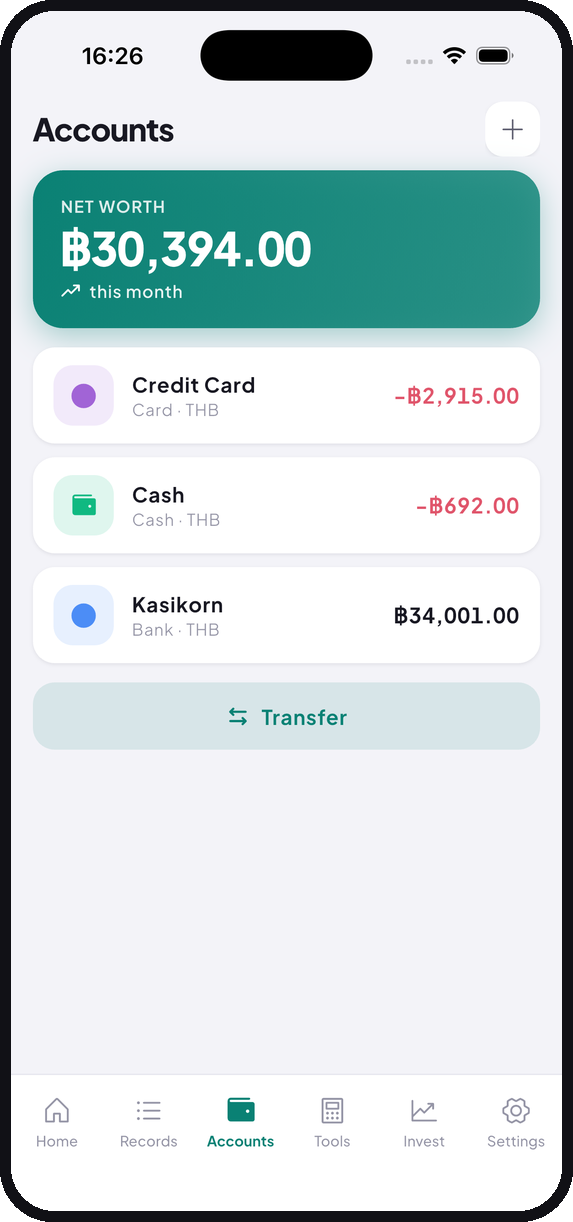
Keeping the card separate matters more than people expect. Card spending is money you’ve promised but not yet handed over. Folding it into your bank balance makes you look richer than you are for most of the month, right up until the statement lands and corrects you all at once.
Pick the account when you log
When you record an expense, choose the account it came from. It’s one extra tap, and it’s what makes per-account balances mean anything at all.
Over a month this tells you something the single-number view can’t: not just what you spent on, but which pot is draining fastest. It’s usually the card. It’s almost always the card.
Transfers are not expenses
Moving money between your own accounts isn’t spending, and Tally has a separate transaction type for it.
This distinction does real work. Withdrawing cash, paying off the card, shifting money into savings: none of that is money leaving your life. If you log an ATM withdrawal as an expense and then log what the cash later buys, you’ve counted the same 5,000 baht twice. Your monthly total goes up for reasons that will be genuinely difficult to find weeks later.
Use Transfer, and the money stays accounted for on both sides.
When the two sides are different currencies
Transfer 500 SGD into a Thai account and the amount that leaves and the amount that arrives are, by definition, different numbers.
Tally records both, along with the rate between them. That means your history reflects what actually happened, including whatever spread your bank or transfer service took, rather than a textbook mid-market rate that never touched your account.
If you move money internationally with any regularity, that gap is worth watching. The difference between the rate you were quoted and the amount that actually landed is a real cost, and it’s invisible unless something is recording both ends.
Two habits that keep balances trustworthy
Count your wallet weekly and compare it to the Cash balance. There’s more on why in the cash and QR guide.
Reconcile the card monthly, when the statement arrives. Compare its total to what the card account says you spent. A mismatch means a missed entry, and finding it while you still half-remember the month is far easier than finding it in a year-end panic.
Looking at one account or all of them
The home screen lets you view everything together or filter to a single account.
The combined view answers “what did I spend this month.” The per-account view answers sharper questions: how much is going on the card, whether the cash budget is holding, how fast a foreign-currency account is drawing down. Different questions, and you’ll want both at different times.
About the net worth figure
With every account recorded, the Accounts screen totals them up.
Treat that number as a trend rather than a precise statement of your wealth, because it’s only ever as good as your logging discipline. The direction it moves over six months is the useful part. The exact figure on any given Tuesday is not.
Tally is free on iOS and Android. No account, no monthly fee.